
Winnebago County's Rolling Police Blotter
The official Winnebago County 72 Hour Dispatch Call Log gives the county its documented multi-day public-safety view. Open Data Rockford publishes it. It runs through Illinois Open Data. The log covers continuing dispatched calls from the prior 72 hours. It refreshes once an hour. A call must stay dispatched at least one hour before it displays.
Treat this as a computer-aided dispatch (CAD) log. It is not a booking roster. It is not a mugshot feed or list of people arrested. The public description states that personal information is not disseminated. Suppressed sexual, domestic, and juvenile calls and revised CAD details keep the picture incomplete. A row means a qualifying call entered the public log, nothing more.
The multi-day design helps you reconstruct timing. You can see when a public call first appeared and where it sits among other events. It cannot answer who was taken to jail. For that, use the arresting agency's releasable record and the WCSO custody inquiry. Once a case is filed, the 17th Circuit Clerk holds the charges and disposition after booking.
The official dataset page displays the county dispatch interface.
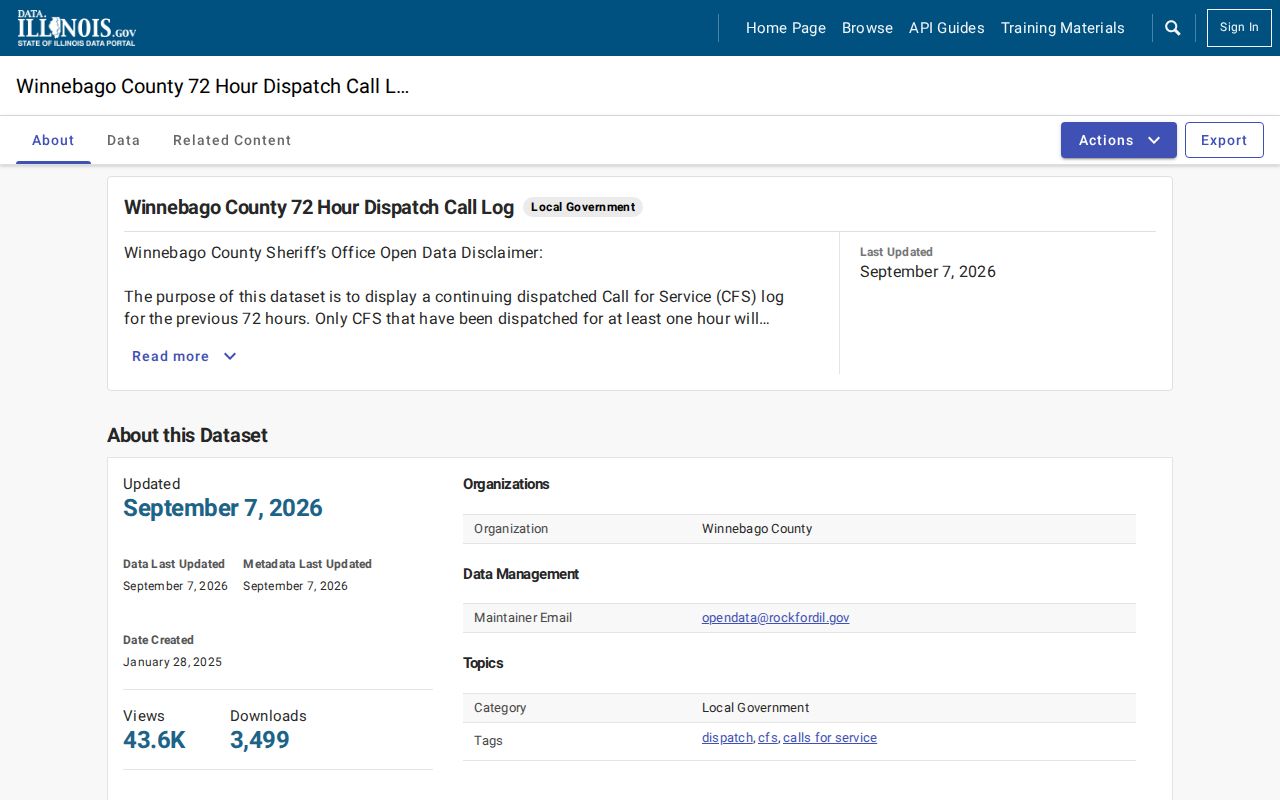
The rolling window shows no names and no gallery.
Read Winnebago Dispatch Records
Work from the newest dispatch time backward. Read each row as a call record. The 72-hour limit is rolling, so a row can age out even while an agency report or court case still exists elsewhere.
- Open the county dataset and note its most recent refresh before drawing any timing conclusion.
- Read the event number, street information, dispatch date and time, and incident description as separate fields.
- Check whether the event lies within the relevant period. Do not read an incident label as a criminal charge.
- For Rockford events, compare the separate RPD 72-hour dispatch dataset, which has its own city scope.
- If a named adult arrest must be confirmed, use the official agency log, WCSO custody inquiry, or records request.
The site's Arrests Last 24 Hours page covers the narrower current-day RPD and jail checks. Don't confuse the two. The official Socrata field documentation describes the county dataset's columns and mechanics.
Event numbers and dispatch times are not booking identifiers.
Winnebago Blotter Entry Fields
The blotter's documented fields describe calls for service. Person-level booking fields are absent. That distinction keeps a street entry or incident label from being misread as proof that someone was booked.
| Field | What it means |
|---|---|
| Event number | A CAD event reference, not a jail booking or court case number. |
| Street number and name | Published location information for the call, subject to suppression. |
| Dispatch date and time | When the call was dispatched, which can differ from any later arrest or booking. |
| Display description | A preliminary incident label, not a filed criminal charge. |
| Name or booking photo | Not part of the public dispatch dataset; use an official arrest or custody source. |
| Disposition | Not supplied; court records must be checked if a criminal case follows. |
Rockford's official 72-hour dispatch dataset plays the same public-safety role for the city. RPD's seven-day Media Arrest Log is another animal. That arrest log can list an approved adult arrest with case number, arrest date and time, location, and charges. Policy-based delay or suppression still applies. A true arrest-log inventory includes a person's name, agency, arrest time, charges as reported, and sometimes a photo. Those fields are absent from the county dispatch schema. Names matter here. When a news report ties an event to a named arrest, check the link against the agency, jail, and court. Never stretch the CAD row beyond its meaning.
Rockford and County Logs Differ
The RPD 72 Hour Dispatch Call Log is the city supplement. It stays separate from the county dispatch dataset and from the seven-day RPD arrest log. One event can spawn several records. A dispatch call, an approved arrest entry, a WCSO custody record, and a later court case can all trace back to it. Each has its own time, purpose, and redaction rules.
The county source refreshes hourly. Weekends and holidays bring no exception. That supports continuous scheduled refresh, not a promise that every event appears. Sensitive calls are suppressed, and current CAD details may change. Three dates together don't prove a weekend surge.
The official Rockford page displays the separate city dataset.
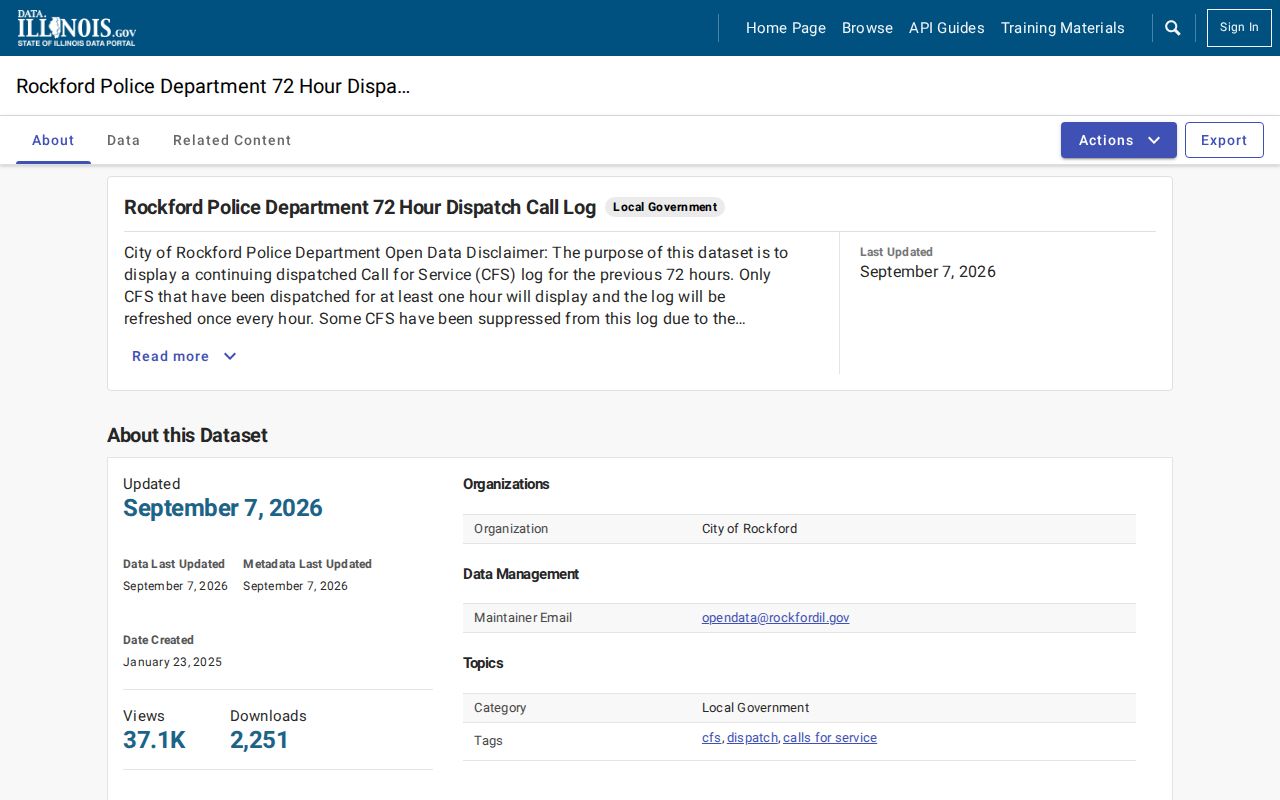
The city view helps compare scope. It still doesn't turn either dispatch log into a named-person arrest feed.
Note: Count calls only as dispatch events; totals should not be labeled arrest counts, charge counts, or crime findings.
Older Winnebago Arrest Records
A county dispatch item rolls out of public view once its rolling period ends. The dataset promises no permanent archive. WCSO gives no numeric retention period for booking records, booking photos, or the online custody inquiry. A live roster entry can vanish after release or transfer, but the underlying record still exists.
For a recent record outside the window, ask WCSO Records/FOIA or the arresting agency. Give the person, dates, agency, and record type. The Illinois 17th Circuit Clerk handles disposition. Illinois's Local Records Act governs local-record management and transfer. It does not guarantee the state archive holds every modern booking photo.
Older records take a different route. The Illinois Regional Archives Depository at Northern Illinois University holds Winnebago jail registers from 1869 through 1920. Those registers are historical jail records, not a continuation of today's blotter. The IRAD Winnebago page is the official starting point.
Note: No public online retention period was located; ask the record-owning agency for the applicable series and schedule.
Winnebago Arrest News Blotters
Start with the agencies themselves. The WCSO press-release archive posts dated announcements the office chooses to share, so it never functions as a full booking roster for Winnebago County. Newsrooms fill in around it. WIFR Crime and Rockford News First both chase arrest, warrant, and investigation stories as they break, sometimes pulling details from online jail records or crediting a sheriff's office photo. What they publish reflects editorial judgment, not a fixed schedule of recent arrests.
The Rockford Register Star adds a deeper archive. Some of it sits behind a paywall. WREX and WTVO/MyStateline cover Winnebago County crime too. Treat none of these as the official police blotter, because a news story is not a booking record.
Third-party arrest sites rank last. Arrests.org keeps a Winnebago year-by-month index, but it has gaps. RecentlyBooked lists no separate Winnebago County section at all. Both may help you spot a name. Neither can confirm who is in custody right now.
A WIFR story shows how this works in practice. It may report a booking shown in online jail records and credit WCSO or the Winnebago County Jail for an image. That account is still just a snapshot from one day. Custody changes, charges change, and courts move cases forward, so the official jail and court records remain the ones to check again.